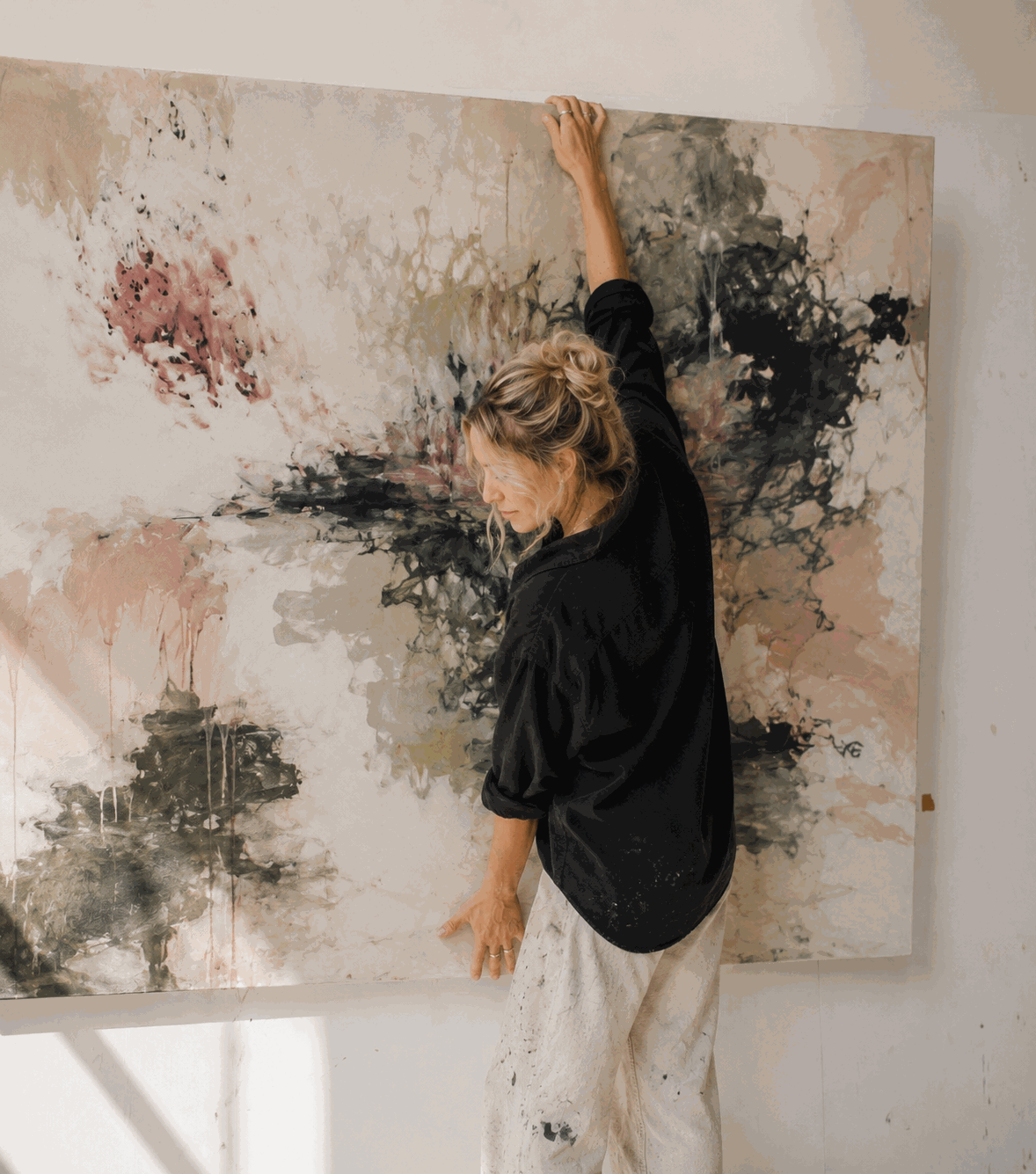

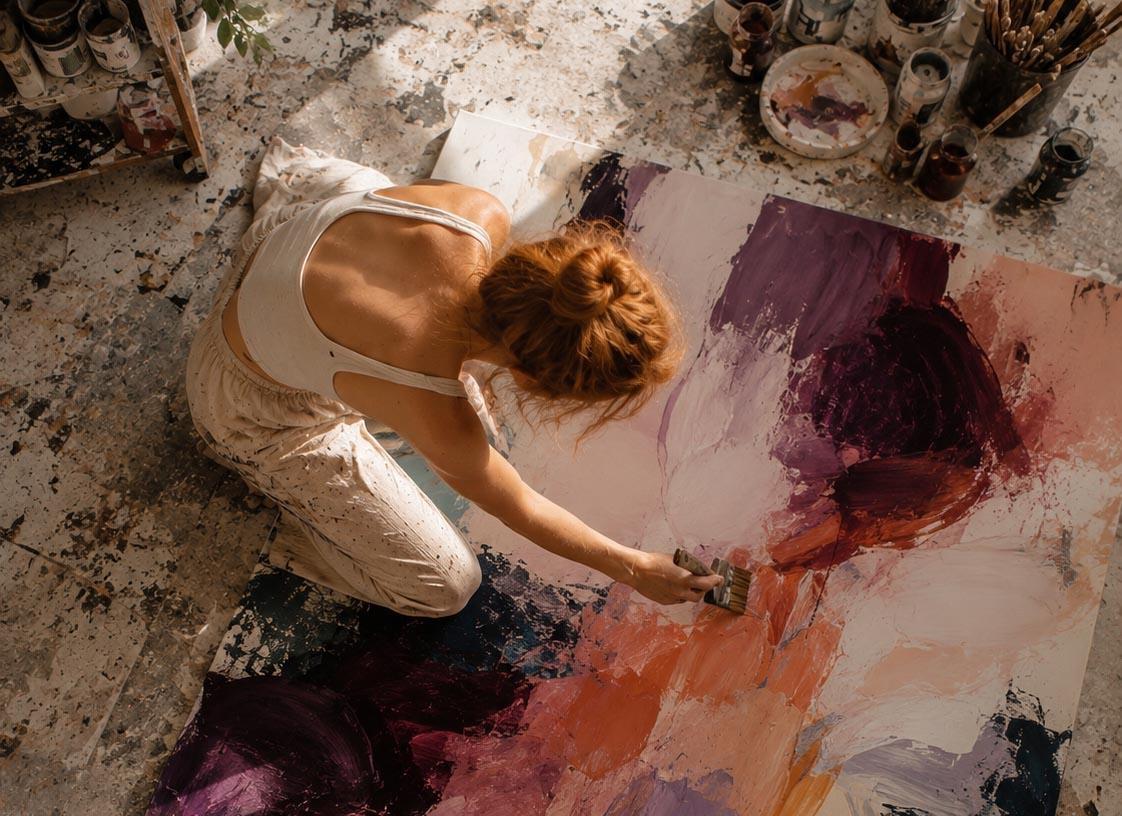
Before she ever had a full-time studio, Neve Calloway was painting theatre sets and murals for cafés and record stores — scrappy, make-it-work jobs that still shape how she approaches a canvas today. Her expressive, colour-driven abstracts are built fast, in layers, often revised dozens of times before she's satisfied. We caught up with her about process, colour, and the wall of paintings she isn't finished with yet.
artfables curator: You spent your twenties doing odd creative jobs — set painting, murals for cafés and record stores. How did that shape the way you paint now?
Calloway: Completely. When you're painting a mural on a deadline, or building a set that has to hold up under stage lights by Friday, you learn to work fast and trust your instincts, because there's no time to overthink it. That scrappy energy never really left me. I still paint that way — quickly, confidently, across the whole canvas at once rather than working one corner at a time.

artfables curator: Your canvases apparently go through a lot of changes before they're finished. What does a piece look like halfway through?
Calloway: Honestly, it can look like a completely different painting. I'll lay down a layer, live with it a while, then paint right over parts of it if it's not saying what I need. A piece might go through a dozen different versions of itself before I call it done. What you see at the end is really just the last decision in a long conversation with the canvas.
artfables curator: You work with big brushes, palette knives, sometimes your hands. Why that approach?
Calloway: I want as little distance as possible between what I'm feeling and what ends up on the canvas. Fine detail work has its place, but it's not mine — I'm after immediacy. Hands and big brushes and knives let me move fast and stay honest. If I overthink a mark, it usually shows.

artfables curator: Tell us about the wall of "unfinished attempts" in your studio.
Calloway: It's exactly what it sounds like — a wall of pieces I haven't given up on but haven't solved yet. I'll leave something there for months, sometimes longer, and come back to it once I've figured out what it's missing. Some of my favourite finished paintings sat on that wall for the better part of a year before I knew what to do with them.

artfables curator: How do you choose colour? Do you plan a palette in advance?
Calloway: Almost never. I don't paint a colour because it matches something. I paint it because the canvas asked for it right then. If I try to plan a palette ahead of time, the painting usually fights me. I'd rather respond in the moment and let the piece tell me what it needs next.

artfables curator: What do you want someone to feel when they bring one of your paintings home?
Calloway: I want it to have some energy in the room — something that doesn't just sit quietly in the background. My hope is that people notice something new in it every so often, long after they've hung it, the same way I kept noticing new things while I was making it.

artfables curator: Any advice for someone just starting to collect, especially if they're drawn to colour-driven work like yours?
Calloway: Trust the piece that actually stops you, not the one that seems safest. Colour is emotional — it hits people differently, and there's no universally "right" palette to collect. If a painting genuinely holds your attention, that reaction is worth more than any advice about what's supposed to work in a room.
Discover the full collection by artist Neve Calloway exclusively to artfables