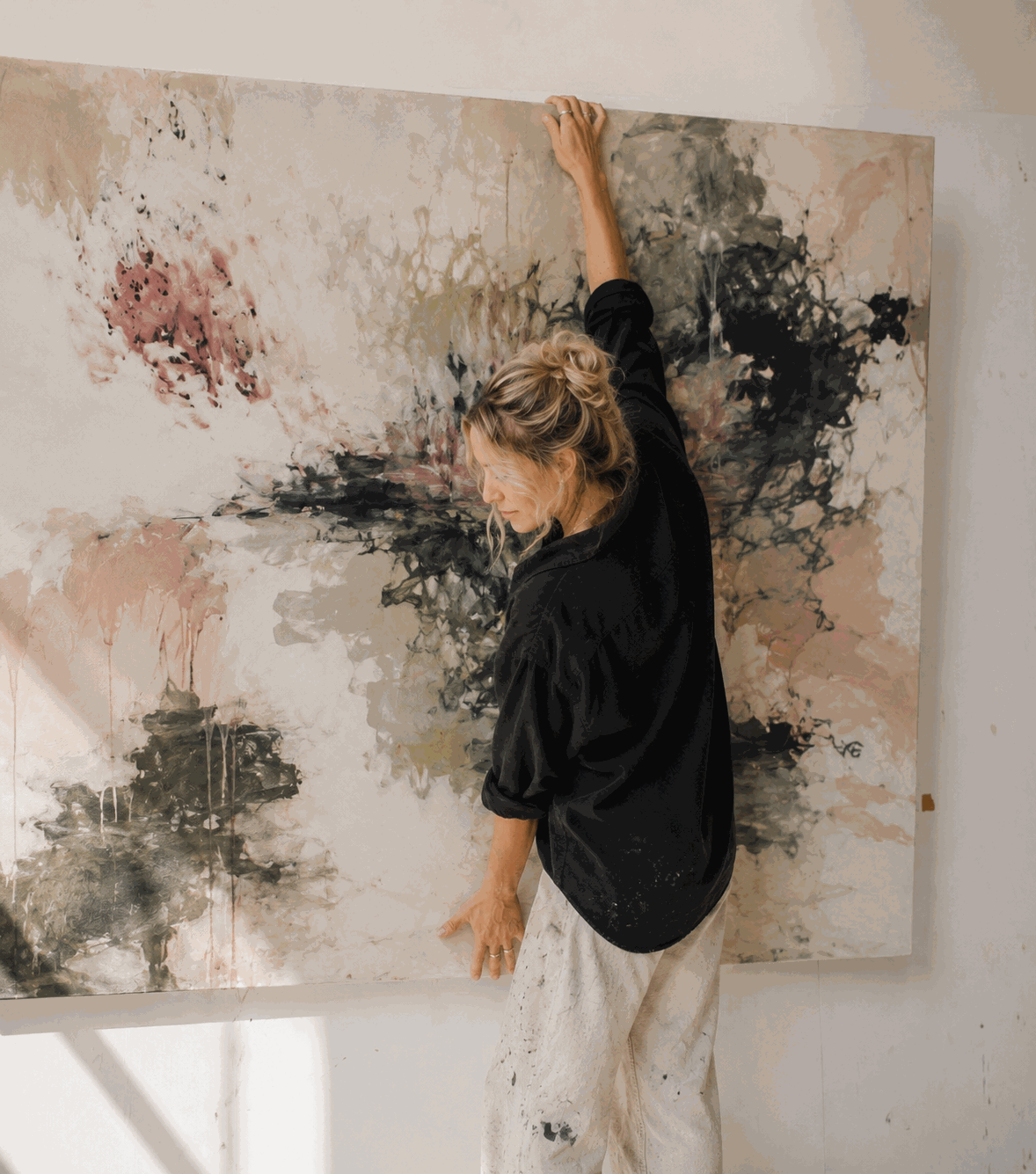

Okoro was born in Osaka to a Nigerian father and Japanese mother, and grew up between two strong visual traditions — Yoruba textile pattern on one side of the family, and Japanese calligraphy and ink painting on the other. That dual influence became the foundation of his practice: large-scale works built from repeated, rhythmic line, closer in spirit to musical notation or woven pattern than to a fixed image. He trained formally in sumi-e brush technique in Kyoto before developing his own looser, more expansive style, working in long continuous gestures across raw linen or canvas. He often listens to music while painting and talks about trying to translate rhythm directly into line, letting the tempo of a track shape the pacing of a mark. "Pattern and rhythm aren't so different," he says. "One's just visual, and the other's audible."


Vendor: Femi Okoro
Edit 9 | Limited Edition Diptych Set


Vendor: Femi Okoro
Orchestra | Limited Edition Print


Vendor: Femi Okoro
Octave | Limited Edition Print


Vendor: Femi Okoro
Symphony 3 | Limited Edition Print


Vendor: Femi Okoro
Strings | Limited Edition Print


Vendor: Femi Okoro
Notes 2 | Limited Edition Print


Vendor: Femi Okoro
Rhythm 3 | Limited Edition Print


Vendor: Femi Okoro
Symphony 2 | Limited Edition Print


Vendor: Femi Okoro
Unwritten Song | Limited Edition Print


Vendor: Femi Okoro
Symphony | Limited Edition Print


Vendor: Femi Okoro
Rhythm 2 | Limited Edition Print


Vendor: Femi Okoro