

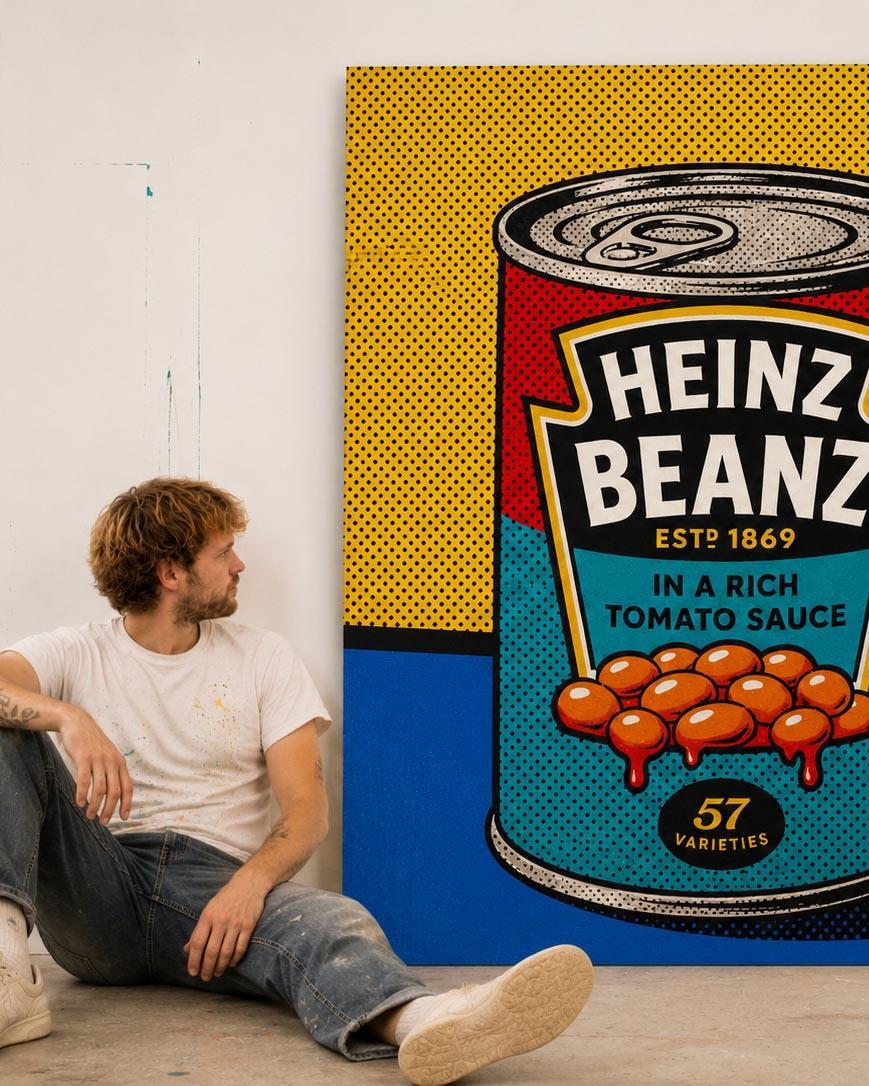
Few art movements are as instantly recognisable — or as widely misunderstood — as pop art. Bright colour, bold outlines, and imagery pulled straight from popular culture made it one of the most accessible movements in modern art history. But behind the recognisable visual language is a body of work that's more critical, more layered, and more collectible than its reputation as "commercial art" sometimes suggests.
What Is Pop Art?
Pop art is a movement that emerged in the mid-20th century, built around imagery borrowed from mass media, advertising, consumer products, and celebrity culture. Rather than rejecting commercial imagery as unworthy of fine art, pop artists embraced it directly — repurposing soup cans, comic strips, and mass-produced portraits as legitimate subject matter for painting and printmaking.
At its core, pop art asked a provocative question: if a culture is saturated with mass-produced images, shouldn't art reflect that reality rather than ignore it? The result was work that felt immediate and familiar, while often carrying a sharp undercurrent of commentary about consumerism, celebrity, and repetition.

A Brief History of the Movement
Pop art developed roughly simultaneously in Britain and the United States during the 1950s and 60s, though the two scenes had distinct characters. The British movement leaned toward ironic, collage-based exploration of American consumer culture viewed from a distance. The American movement, centered largely in New York, embraced consumer imagery more directly — turning supermarket products, celebrity portraits, and comic book panels into large-scale paintings and prints.
Key techniques associated with the movement include screen printing and other reproducible processes, which allowed pop artists to literally mimic the mass-production methods of the advertising world they were commenting on. This wasn't incidental — the process of making the work was often as much a part of the statement as the imagery itself.
Defining Characteristics of Pop Art
- Bold, flat colour with minimal gradation, often mimicking commercial printing
- Recognizable, everyday subject matter — products, celebrities, comic imagery
- Repetition as both a technique and a commentary on mass production
- High contrast and graphic outlines, borrowing visual language from advertising and print media
- A tension between irony and celebration — pop art rarely tells you definitively whether it's critiquing consumer culture or reveling in it, and that ambiguity is part of its lasting appeal

Why Pop Art Still Resonates With Collectors
Pop art has aged unusually well for a movement so tied to a specific cultural moment, for a few reasons:
- It remains visually confident. Bold colour and graphic clarity read just as strongly in a contemporary interior as they did decades ago.
- It's inherently conversational. Pop art invites discussion — about culture, commerce, and meaning — in a way few movements do as naturally.
- Contemporary pop art continues to evolve, with current artists applying the movement's visual language to new subjects: social media, modern celebrity, digital culture, and consumerism in its current form.
- It pairs well within a broader collection. Because of its graphic clarity, pop art often works as a bold counterpoint to more subdued abstract or expressive pieces elsewhere in a collection.
What to Look For When Collecting Pop Art
- Craftsmanship behind the simplicity. Pop art can look deceptively simple — evaluate colour precision, composition balance, and print quality closely.
- Concept, not just imagery. The strongest pop art pieces have a clear point of view, not just a recognisable subject.
- Edition quality, for prints. Since pop art has deep roots in printmaking, understanding the edition — numbering, print method, and certificate of authenticity — matters as much as the image itself.
- How it will live in your space. Pop art tends to read as a statement piece; consider giving it room to stand on its own rather than crowding it with competing decor.

Frequently Asked Questions
What's the difference between pop art and abstract art? Pop art centers on recognisable, culturally specific imagery — products, celebrities, media — while abstract art avoids recognisable subject matter entirely. They're often visually distinct but can share bold use of colour and graphic composition.
Is pop art still being made today? Yes. Contemporary pop artists continue to apply the movement's core techniques and ideas to current cultural imagery, keeping the movement active and evolving rather than frozen in its mid-century origins.
Why is pop art often created as limited edition prints? Printmaking has been central to pop art since its origins, partly because reproducible techniques echoed the movement's commentary on mass production. Limited, numbered editions allow that printmaking tradition to continue while preserving exclusivity for collectors.
Is pop art a good starting point for new collectors? Its visual accessibility often makes pop art an approachable entry point, though the most collectible pieces reward the same scrutiny as any other movement — composition, concept, and quality of execution.
How do I display pop art at home? Because of its graphic boldness, pop art generally works best with breathing room — a clean wall, moderate surrounding colour, and enough space for the piece's colour and contrast to stand out rather than compete with a busy backdrop.