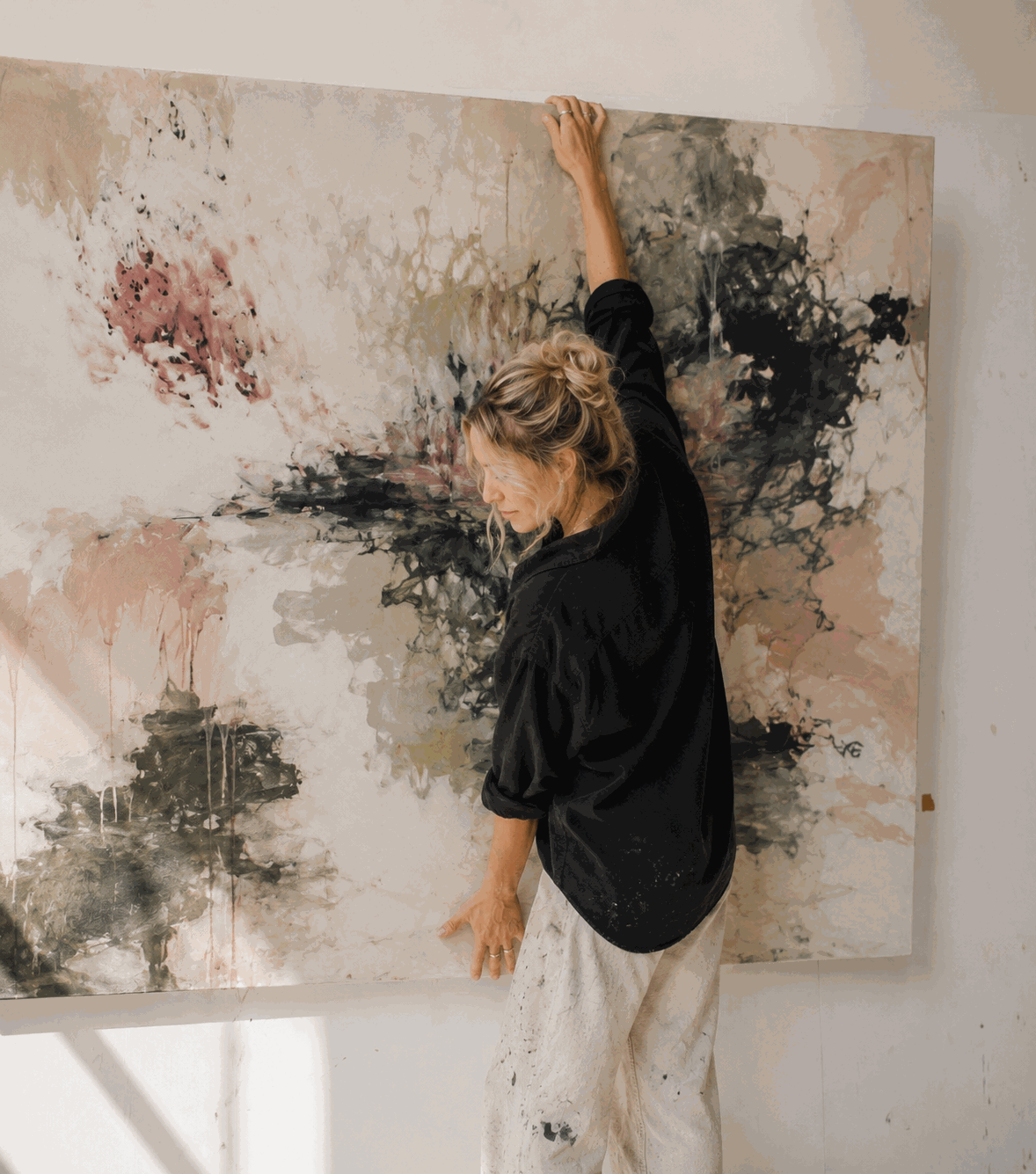


There is a certain kind of purchase that feels satisfying in the moment and forgettable within a year. An oversized canvas print, chosen because it fills a wall and costs little to do it, is one of the most common examples in home design. It solves a problem — the blank space above the sofa — without ever asking a more interesting question: what do you actually want to live with?
At artfables, we believe that question is worth asking. And we believe the answer is rarely "whatever is biggest and cheapest."
The Illusion of Scale
Large-format canvas prints are appealing for an obvious reason: they make an immediate visual statement. A six-foot-wide piece commands a room in a way a modest 16x20 cannot, at least not on first glance. But scale is not the same as quality, and a large empty gesture is still empty.
Most of these prints are not created by an artist with a point of view. They are stock imagery, licensed in bulk, printed on demand, and shipped from large-volume manufacturing facilities — a significant share of them overseas, optimised for cost and speed rather than craft. The canvas is thin. The inks fade unevenly, often within a few years of normal sunlight exposure. The stretcher bars warp. There is no edition, no numbering, no artist to speak of — because the image was never meant to be collected. It was meant to be sold in volume and replaced without much thought.
That's not a flaw in any single product. It's the entire model. Volume and permanence are opposing goals, and when a business is built around the first, the second is the first thing to go.

What Curation Actually Buys You
Choosing a curated piece — an original painting or a strictly limited edition print — is a different transaction entirely.
It buys you intention. A curated piece has passed through a filter: an artist's eye, a considered composition, a reason for existing beyond decorating a wall. When you choose it, you're not filling space. You're making a decision about what you want to look at every day, and why.
It buys you durability. Work produced in small runs, on archival materials, with attention to pigment and process, is built to be lived with for decades — not replaced when the color shifts or the corners fray. A well-made piece on the right substrate, framed and cared for properly, can outlast the room it's hanging in.
It buys you scarcity that means something. A limited edition — numbered, capped, never reprinted once the run is closed — has a ceiling on how many exist in the world. That's not a marketing device. It's a structural fact that shapes the piece's meaning and its value over time. A print that anyone can reorder indefinitely is not scarce; it's simply inventory.
It buys you a story. Every piece in a considered collection connects to a person — a working artist with a process, a perspective, and a body of work it belongs to. That context is part of what you're bringing into your home. A factory print has no such story, because there was never anyone to tell it.
A Smaller Piece, Chosen Well, Beats a Large Piece Chosen Carelessly
This is worth saying directly: a well-chosen 20x24 original will do more for a room — and hold its value and integrity longer — than an oversized print bought to solve a spatial problem. Scale can absolutely be part of a considered choice; large-format originals and editions have their place, and can anchor a room beautifully. But size should follow the decision to collect something meaningful, not substitute for it.
The difference shows up over time. A curated piece tends to become more interesting to live with, not less — you notice new things in it a year in, five years in. A decorative print, by contrast, tends to fade into wallpaper almost immediately, precisely because it was never asking to be looked at closely in the first place.

Supporting the Artist Behind the Work
There's also a simpler case to be made, separate from questions of longevity or aesthetics: when you buy a curated original or limited edition, you are supporting an artist's practice directly. That purchase has a place to land — it funds the next body of work, sustains a career, and keeps the work of building a distinct creative voice viable. A mass-produced print, licensed once and reproduced indefinitely by a manufacturer, does none of that. The economics simply don't run in that direction.
Collecting, at its best, is a quiet form of patronage. It says: this perspective is worth continuing.
What to Look For When Choosing a Piece
If you're moving away from decorative prints and toward a more considered approach to art in your home, a few things are worth paying attention to:
- Edition size and numbering. A true limited edition states how many exist and where a given piece falls in that run. If a "limited" print can be reordered at any time, it isn't actually limited.
- Certificate of authenticity. This is standard practice for both originals and legitimate limited editions, and it matters for provenance and future value.
- Materials. Archival paper, artist-grade pigments, and proper canvas or panel construction are the difference between a piece that lasts and one that doesn't.
- The artist's body of work. A single image tells you little. A consistent creative perspective across multiple pieces tells you the work comes from an actual practice, not a one-off asset.
- Fit with intention, not just wall space. Choose the piece first. Let the wall accommodate it — not the other way around.

The Wall Above the Sofa Isn't the Point
A home filled with curated work looks different from one filled with décor, even when the difference isn't immediately obvious to a visitor. It reads as considered. It ages well. And it tends to mean more to the person living with it, because it was chosen rather than defaulted into.
Size was never really the question. The question is whether what's on your wall was made by someone, for a reason — or simply printed, in bulk, to fill it.