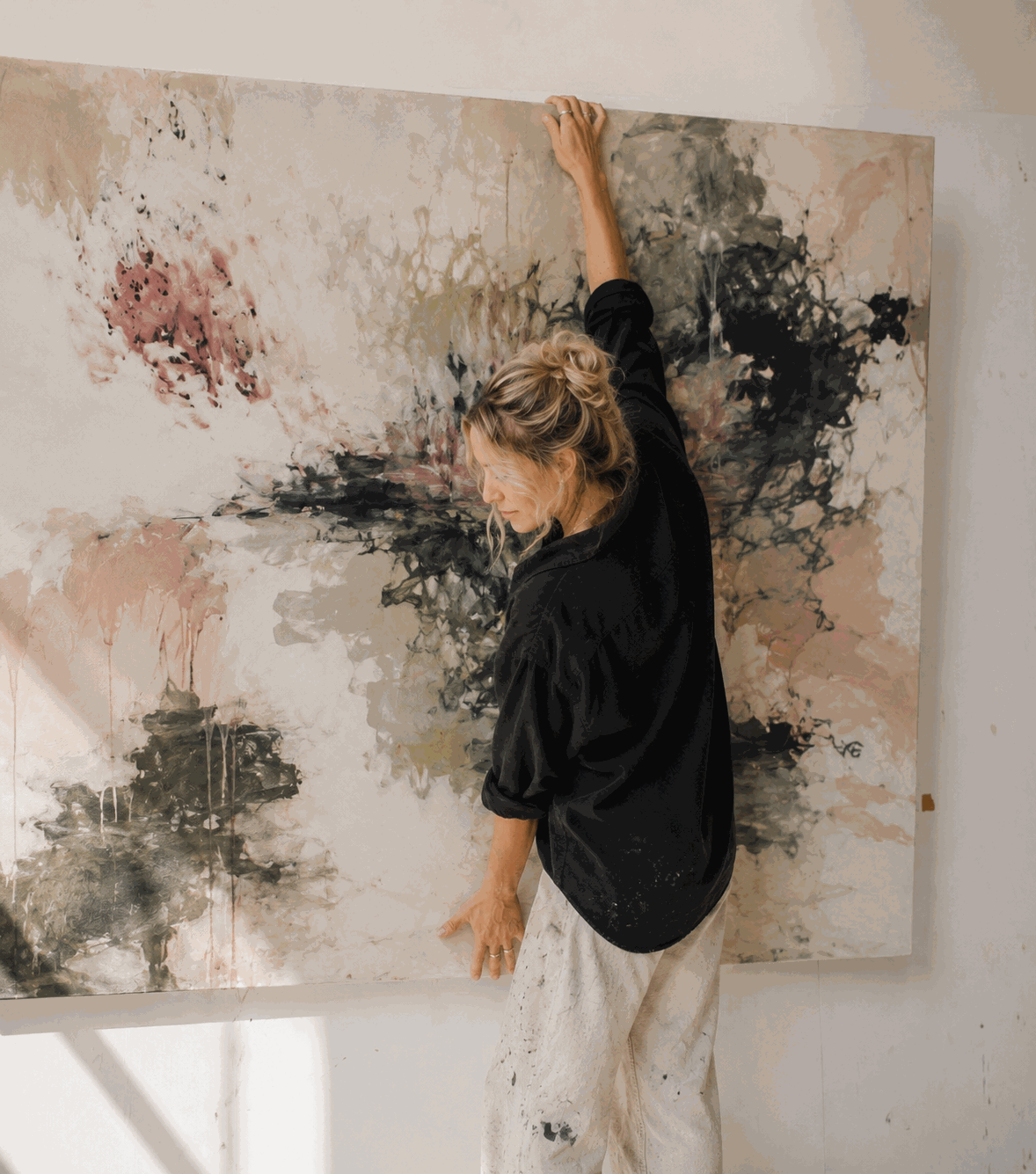

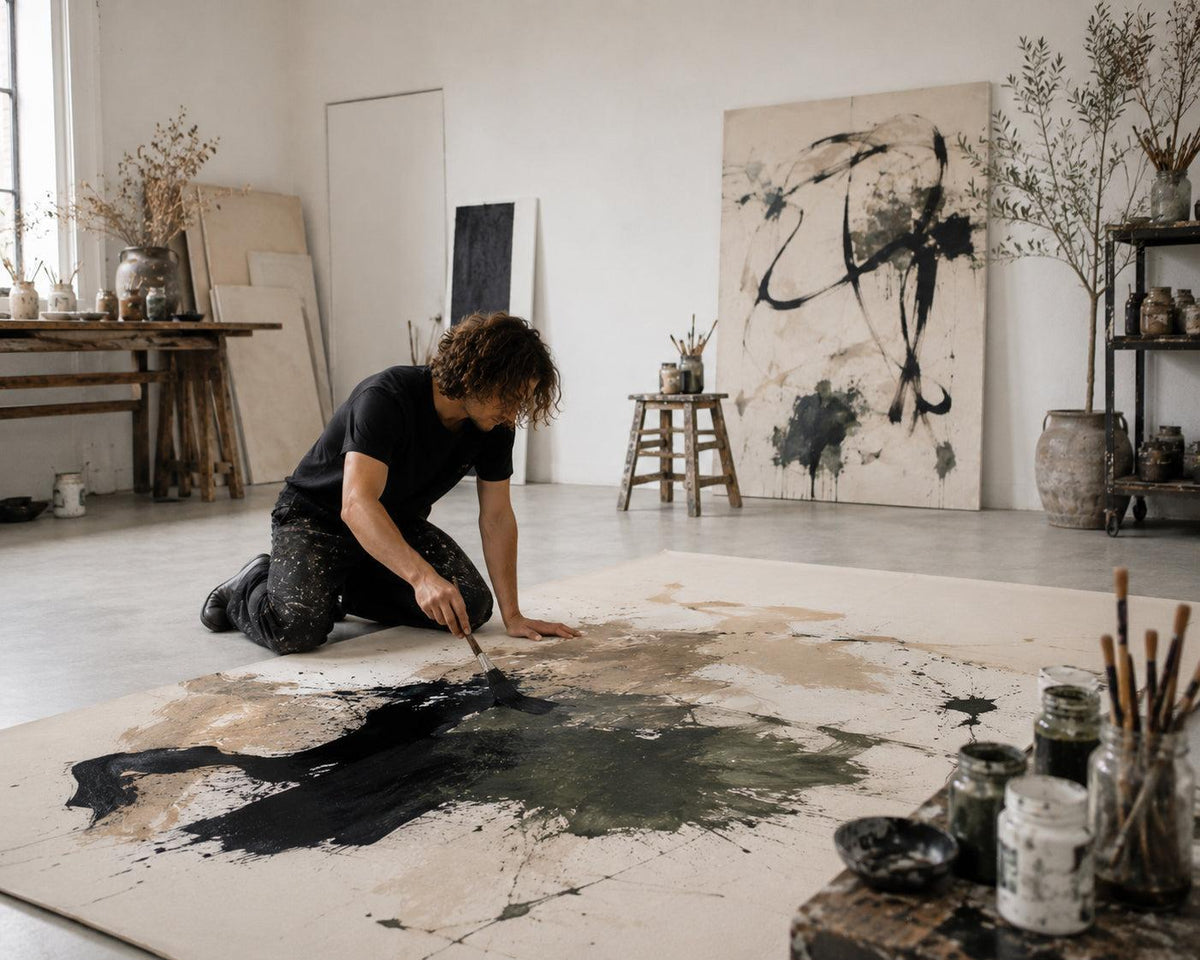
Alexander Kleinberg trained at an art academy in Düsseldorf before relocating to New York in his late twenties, drawn by the city's history of large-scale, gestural abstraction. Nearly two decades on, his physical, layered paintings — built in deep, deliberate palettes — remain some of the most collected work on artfables. We sat down with him to talk about process, darkness, and why he still thinks in German.
artfables: You trained formally in Düsseldorf before moving to New York. How did that move change the way you paint?
Kleinberg: It didn't happen overnight. My training in Düsseldorf was rigorous — very structured, very European. You learn control first, instinct second. New York flipped that order for me. I found this looser, more physical energy here, this history of painters who worked from the whole body, not just the wrist. It took me a few years to let go of some of that early discipline. I still think in German sometimes when I'm planning a piece, but I paint in English.

artfables: Your work is often described as physical. What does that actually look like in the studio?
Kleinberg: I don't sit. I don't work from one fixed spot. I paint standing, moving around the canvas, sometimes circling it for a while before I make a mark. The whole body is part of it — the reach, the weight behind a stroke, the distance I step back to look. A painting builds through a lot of layering and reworking. It finds its own balance eventually, but only after I've fought with it a bit.
artfables: Your palette leans dark. What draws you there?
Kleinberg: People assume dark means dramatic, or moody on purpose. That's not really it for me. I work with darker tones because that's where I find the most honest color. Black isn't empty — it's every color that hasn't decided what it wants to be yet. When you spend real time with one of my paintings, your eyes adjust. You start seeing what's underneath. That's the part I'm actually interested in — not the absence of light, but what's still visible once you give it a moment.

artfables: Do you know when a piece is finished, or does something tell you?
Kleinberg: It's more that the fighting stops. Early on, a canvas resists you — you put down a layer, it's wrong, you rework it, it's still not settled. At some point it stops pushing back. That's usually when I know to put the brush down, even if I can't always explain why.
artfables: Is there a painting that changed something for you as an artist?
Kleinberg: There's usually one a year that does that — teaches me something I didn't know I needed. I won't pretend I can always name it in the moment. Usually I only recognize it a few pieces later, looking back and seeing where the shift happened.

artfables: What do you hope someone feels standing in front of your work?
Kleinberg: I'm not trying to hand someone a feeling. I'd rather they find their own. If a painting holds someone's attention a little longer than they expected, and they're still noticing new things in it a year after they've hung it, that's the whole goal.
artfables: Any advice for someone building a collection, especially if they're drawn to darker work?
Kleinberg: Don't rush past it because it takes more effort. Lighter work is easier to like quickly. Darker work asks you to spend real time with it before it gives anything back. If you're willing to do that, it tends to reward you more in the long run than something that gave you everything on the first look.